Maharashtra
Midnight's ChildrenMaharashtra enters the narrative as a political claim carried in language, not as a boundary drawn by rivers or mountains. The state’s formation follows a mass demonstration in Bombay and a riot triggered by Saleem’s accidental intervention; its creation makes Bombay the capital of Maharashtra and places Saleem, in his telling, on the winning side.
Language and the Unsettled State
After the States Reorganization Committee’s recommendations were implemented, India was divided into fourteen states and six centrally administered territories. Yet Bombay’s future remained unresolved. While Kerala, Karnataka, and Madras were associated with particular languages, no comparable settlement had been made for Bombay, and marches in the city grew into organized political movements.
The Samyukta Maharashtra Samiti championed Marathi and demanded a Maharashtra state in the Deccan. The Maha Gujarat Parishad, by contrast, promoted Gujarati and envisioned a state north of Bombay City extending toward the Kathiawar peninsula and the Rann of Kutch. Their competing claims made language a means of defining territory and political belonging. For the children confined to Methwold’s Estate, the demonstrations first appeared as a vast, compelling procession; its political stakes were not yet clear to them.
The Procession and Saleem’s Rhyme
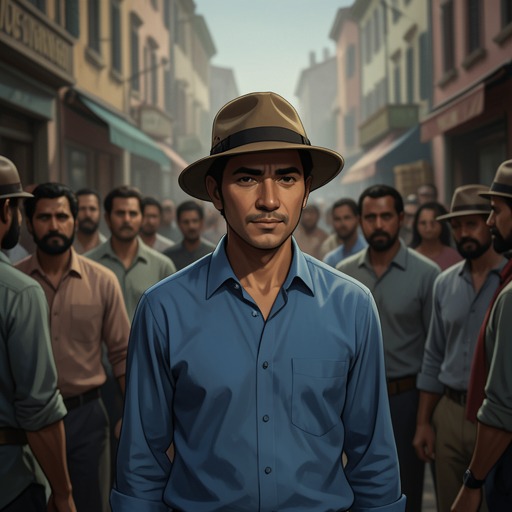
In February 1957, shortly after the family returned from Agra, a procession flooded Warden Road and took two days to pass. It included shopkeepers observing a hartal and striking textile workers. Saleem and the other children were forbidden to go down the hill, but they crept partway toward the road to watch. The procession had already been associated with danger: the children had heard that marchers killed Doctor Narlikar.
A disturbance in Evie Burns’s house sent Saleem careering by bicycle down the slope and into the procession. The marchers stopped him and asked which language he preferred. Unable to answer in either Marathi or Gujarati, he recited a Gujarati rhyme he had learned at school. Its words began as a taunting schoolyard verse, but Saleem’s account emphasizes how the crowd repeated it: the rhyme became a chant that traveled through the procession and turned into a song of war.
Riot and Political Consequence
That afternoon, the head of the Samyukta Maharashtra Samiti procession met the head of a Maha Gujarat Parishad demonstration at Kemp’s Corner. The competing crowds took up the rhyme and fell into violence. The first language riot left fifteen people dead and more than three hundred wounded.
Saleem subsequently describes himself as directly responsible for triggering the violence that ended with the partition of Bombay State. The state was divided, and Bombay became the capital of Maharashtra. His claim gives a child’s accidental utterance an immense political consequence, while his qualification that he was at least on the winning side underscores how personal memory folds public history into a narrator’s own fortunes.
A State Made in Speech
Maharashtra’s emergence is presented through the collision of language, mass politics, and the narrator’s unreliable sense of personal causation. The political division did not follow natural features of the land: it was shaped by claims made in Marathi and Gujarati, and those claims became consequential through demonstrations, slogans, and violence.
The episode also shows how a phrase can change register as it moves between settings. A rhyme learned for bullying becomes a crowd chant, then part of the sound of a riot, and finally a marker in Saleem’s account of the state’s formation. Maharashtra is therefore both a political outcome and a point where the novel’s intimate childhood narrative intersects with the making of modern India.